




Ultimate Guide to Fresh Flower Bouquets Online
Master the essentials of Ultimate Guide to Fresh Flower Bouquets Online including common pitfalls to avoid with The Flower Boutique by your side.

At a Perth kitchen bench just before dawn, someone trims rose stems beside a sink while eucalyptus spills across the counter and a half-finished bridal bouquet waits in a vase of cold water. The scissors are wet. The kettle has barely clicked off. And for a minute, the whole wedding feels like it lives inside that one bunch of flowers.
If you are figuring out how to make fresh flower bouquets for weddings, this is the part that matters most: not the dreamy mood board, but the real-life handling. The water. The timing. The 7 a.m. decisions that decide whether the bouquet still looks alive at the first kiss and again at the reception entrance.
I have made bouquets in hot weather, in cramped prep rooms, and once on a dining table five minutes from Kings Park because traffic blew up the schedule. Fresh flowers are generous, but they are not forgiving. Treat them well and they reward you in photos, scent, and that little intake of breath when the bouquet first appears. Rush them, overhandle them, or leave them in a warm car for twenty minutes, and they tell on you fast.
Fresh flowers have movement. That is the first thing you notice when you see a bouquet in a real ceremony rather than on a screen. A garden rose opens a touch more by the hour. Ranunculus catches light in thin layers. Eucalyptus softens the outline and adds scent before anyone even sees the bride.
Artificial flowers can absolutely be practical, especially for keepsakes or long-distance setups, but they read differently in close-ups. Fresh blooms usually give you softer edges, more variation, and a kind of natural looseness that works beautifully in portrait photos from places like Cottesloe, Guildford, or a winery in the Swan Valley. Guests notice it too. They may not say, “Lovely texture contrast,” but they do feel the difference.
Fresh-cut flowers need water and cool handling after they are cut. Simple truth. A wedding bouquet should be assembled as close to the event as practical so the blooms look their best when they are actually being carried, photographed, and handed around for detail shots.
That does not mean you do everything at the last second. Usually, you condition stems the day before, sort your flowers by type, prep ribbon, clean buckets, and clear bench space. Then you build the final bouquet on the morning of the wedding — or even a few hours before an afternoon ceremony. For an 11 a.m. start in Fremantle, I would rather finish at 8:30 than at 10 p.m. the night before.
Perth weather changes the rules. Warm air, direct sun, and hot car interiors can shorten the life of cut flowers during that awkward ceremony-to-reception stretch. You might only need the bouquet to look fresh for six hours, not six days — but those six hours are non-negotiable.
Never think of a bouquet as “fine for a little while” in the boot. I have seen roses go papery after a January drive across town, and hydrangea wilt during photos because someone set the bouquet on a sunny windowsill while the dress was being steamed. Transport it upright, keep it in water when possible, and give it air-conditioning, not optimism.
Treat the bouquet like a perishable item: the closer to the ceremony it’s finished, the better it will hold up.
That one mindset clears up half the usual bouquet drama before it starts.
A wedding bouquet usually has three jobs happening at once. Focal flowers give you visual impact. Filler flowers create volume and soften gaps. Foliage builds shape, movement, and texture. Once you see bouquets this way, stem shopping gets much easier.
| Part of the bouquet | What it does | Common examples |
|---|---|---|
| Focal flowers | Draw the eye and set the style | Roses, ranunculus, orchids, dahlias |
| Filler flowers | Add body, softness, and transitions | Waxflower, spray roses, baby’s breath, stock |
| Foliage | Shapes the outline and adds texture | Eucalyptus, olive leaf, ruscus |
Eucalyptus shows up in Australian-style arrangements for good reason. It smells clean, it creates space around heavier blooms, and it helps a bouquet feel relaxed rather than packed like a ball. If you start with all focal flowers and no support, your bouquet can look expensive but strangely stiff. If you use all filler, it goes fluffy and forgettable. You want balance.
Bigger is not always better. A compact bouquet can look elegant with a slim satin dress. A fuller shape often suits a structured gown, cathedral veil, or wide ceremony space where tiny flowers disappear in photos. Think about scale the same way you would think about earrings or shoes — the bouquet has to belong with the whole look.
The venue matters too. In a small registry room in Perth CBD, an oversized cascade may feel like too much. In a big garden ceremony or a heritage hall, a tiny bunch can vanish. I usually tell people to stand back three or four metres and ask, “Does this shape still read clearly?” If the answer is no, adjust before you tie.
You do not need fancy jargon here. Most wedding bouquets fall into a few practical shapes, and each one behaves differently in the hand. Hand-tied bouquets are especially common because they feel natural, photograph well, and are built by crossing stems in a spiral before tying them off.
| Shape | Best for | What to watch |
|---|---|---|
| Round | Classic, formal weddings | Can look rigid if packed too tightly |
| Hand-tied | Most modern weddings, relaxed styling | Needs a clean spiral to stay balanced |
| Cascading | Dramatic gowns, larger venues | Heavier to carry and trickier to transport |
A bouquet is not just a bunch of flowers; it is a planned structure with one job: hold together beautifully in someone’s hands.
Once you understand that, your flower choices start getting smarter fast.
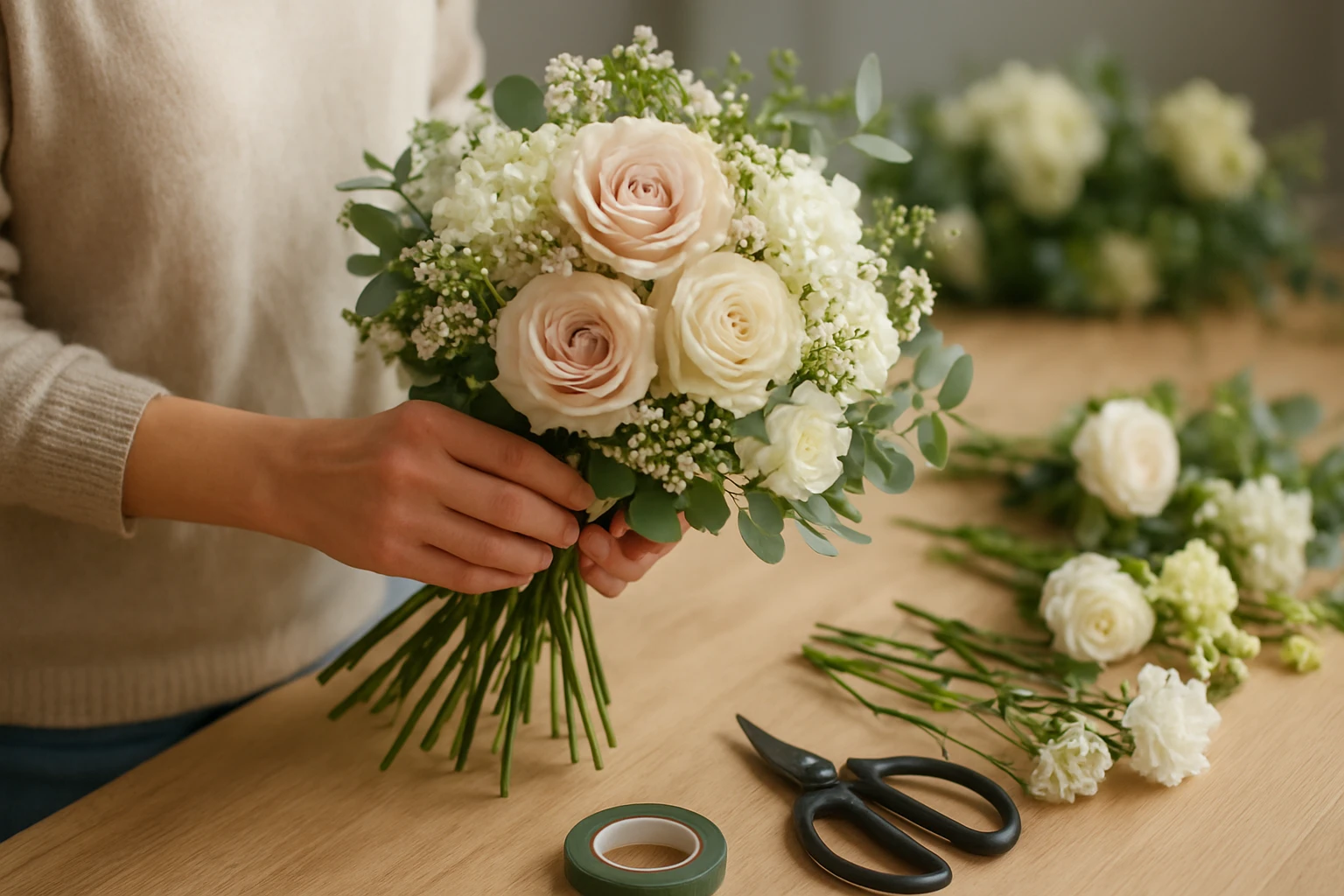
Before you arrange a single bloom, set up your work area. A clean sink, sharp shears, two buckets of fresh cool water, and enough bench space to rotate the bouquet without elbowing a coffee mug into it — that is your real starting point.
Skipping that leaf removal step is one of the fastest ways to end up with cloudy water and unhappy flowers. Bacteria builds quickly. Clean water buys you time, and on a wedding day, time is gold.
The spiral sounds fiddly until you do it twice. Then it becomes muscle memory. Hold your first focal flower in one hand. Add the next stem at an angle across it. Turn the bouquet slightly in the same direction every time, then add the next stem at that same angle. You are not stacking stems straight up and down. You are crossing them.
A spiral build helps the bouquet sit neatly in the hand and stay balanced. It also makes trimming the stems easier later because the bundle already wants to sit together rather than splay out.
If the stems are fighting each other in your hand, stop and rebuild the spiral before you tie anything.
I know it is tempting to wrestle through and hope ribbon fixes it. Ribbon fixes appearance. It does not fix structure. If the bouquet feels lopsided at stem eight, undo the last four. That two-minute reset is faster than rescuing a crooked bouquet at the venue.
When the bouquet shape feels right, tie it at the natural bind point — usually where your hand has been holding the stems. Use twine, floral tape, or both. Secure means secure. A loose tie is how a bouquet slowly opens up and turns floppy halfway through family photos.
If you are using satin ribbon, keep it above the water line. If you want exposed stems for a natural look, great — just make sure the handle still feels comfortable for twenty or thirty minutes of carrying. Pretty is not enough. It has to feel secure in a real hand, in real heat, through hugs, photos, and one nervous grip before the aisle walk.
The calmest wedding bouquets are built from the clock backward. Start with ceremony time, then reverse-engineer everything else. This stops you from making flowers too early or leaving ribbon work for the same moment hair and makeup starts running late.
| Time before ceremony | What to do | Why it helps |
|---|---|---|
| 24 hours | Condition stems, clean tools, prep ribbon | Less pressure on the wedding morning |
| 4 to 6 hours | Build the bouquet | Fresh look with enough buffer for issues |
| 1 to 2 hours | Final tidy, replace bruised blooms | Keeps the bouquet photo-ready |
| Just before leaving | Wrap ribbon, transport upright | Reduces heat and handling time |
For a 3 p.m. ceremony in Subiaco, you might condition on Friday, build late Saturday morning, then do the final ribbon right before the bouquet leaves the house. That schedule works because it respects the flowers, not because it feels impressive on a spreadsheet.
Fresh flowers last longer in a cool environment and out of direct sunlight. That sounds obvious until the bouquet gets parked beside a bright window “just for a photo.” Don’t. Cold water, shade, and minimal handling beat almost every fancy trick people try online.
Transport bouquets upright so the shape stays protected and stems do not crush each other. Use a bucket, vase carrier, or a snug box with support around the container. Keep the air-conditioning on. Twenty minutes in a parked car near Elizabeth Quay can undo an hour of careful work, especially with softer blooms like sweet peas, tulips, or hydrangea.
Always keep spare material. A bloom can open too far. A rose can bruise. A ribbon can snag on a zipper. None of that is a disaster if you planned for it. Keep three to five extra stems from your main flower mix, plus a bit of foliage, tape, ribbon, pins, and clean snips nearby.
If you are buying locally or having support from a florist such as The Flower Boutique, ask for a few compatible spare stems and a simple emergency touch-up plan. You may never need it. Lovely. But backup flowers are like spare buttons on a suit — boring right up until they save the day.
Shorter handling time usually beats elaborate styling when the weather is warm.
That is especially true in Perth from November through March.
Flowers that are already fully open at breakfast often look tired by the ceremony’s end. This is a classic DIY mistake because open blooms look gorgeous when you are choosing them. I get it. They seduce you. But wedding flowers need a little runway.
Choose blooms that are partly open, healthy, and firm enough to travel. Garden roses can have some softness, sure, but if the outer petals already look papery at 8 a.m., they are not your long-game friend. On warm days in Perth, slightly tighter is usually smarter.
No recut. Dirty bucket. Leaves in the water. Bouquet left dry on a bench while everyone hunts for earrings. That chain of tiny shortcuts creates most wilt problems I see. Not bad luck. Just skipped prep.
Recutting stems helps water uptake. Removing submerged leaves reduces bacterial growth. Clean containers and fresh water keep everything fresher after cutting. None of this is glamorous, but it works. I once watched a beautiful white hydrangea arrangement sag before the vows because the stems had not been properly conditioned after pickup. It was fixable, but no one wants emergency triage in formalwear.
A bouquet can loosen if the stems are not tied securely after the spiral is built. Then transport makes it worse. Petals bruise. Delicate stems snap. Ribbon wrinkles. Someone grabs the bouquet by the blooms instead of the handle, and suddenly the front side is not the front side anymore.
The biggest bouquet problems usually happen before the ceremony, not during it.
That is why logistics matter just as much as flower choice.
You do not need a giant florist studio to make a strong bouquet. You need sharp tools, clean water, and a plan you can execute without chaos. Start there.
| Item | Need level | Why it matters |
|---|---|---|
| Sharp floral shears | Essential | Clean cuts protect stems and speed prep |
| Clean buckets or vases | Essential | Hold conditioned flowers in fresh water |
| Floral tape or twine | Essential | Secures the spiral at the bind point |
| Ribbon | Essential | Finishes the handle neatly for carrying |
| Pruning knife | Optional | Handy for experienced stem work |
| Pins or pearl pins | Optional | Useful for securing ribbon details |
| Spare wrap or box support | Optional but smart | Makes transport cleaner and safer |
If you are sourcing flowers in Perth, ask practical questions, not just “What looks pretty?” You want stems that suit your date, travel well, and can hold up in local conditions. A good supplier will understand exactly why you are asking.
Those questions work whether you are shopping a wholesaler at 6 a.m. or ordering through a family florist for a smaller wedding. They also help you avoid building a bouquet around one fragile stem that looked great in the cooler and terrible by lunch.
Here is the nice part: once you can build a balanced hand-tied bouquet, you can use the same skills almost anywhere. Sympathy bouquets usually call for softer handling, gentler palettes, and dependable flowers that travel well. Celebration bouquets can be brighter, looser, and lighter in structure. Gift bouquets often need wrapping that protects the stems for pickup or delivery.
The technique stays familiar. Recut stems. Strip lower leaves. Build in a spiral. Tie firmly. Keep cool. That works for weddings, funerals, birthdays, thank-you bouquets, and heartfelt “thinking of you” flowers. The style changes. The discipline does not.
You do not need a huge toolkit to make a beautiful bouquet; you need sharp tools, clean water, and a clear plan.
A lot of the stress disappears once you trust that simple system.
A wedding bouquet stays beautiful when you plan backward from the ceremony, build a clean spiral, and protect the flowers from heat right up to the walk down the aisle.
That is how to make fresh flower bouquets for weddings without turning the morning into a scramble: prep early, finish late, keep everything cool, and carry spare stems.
What would change in your floral plan if you treated the bouquet like the most perishable part of the whole wedding day?
Personalised Flower Boxes and tailored event florals help Perth planners and gift-givers secure elegant arrangements for weddings, funerals, celebrations, and heartfelt moments.
Plan Your Flowers0 comments

